
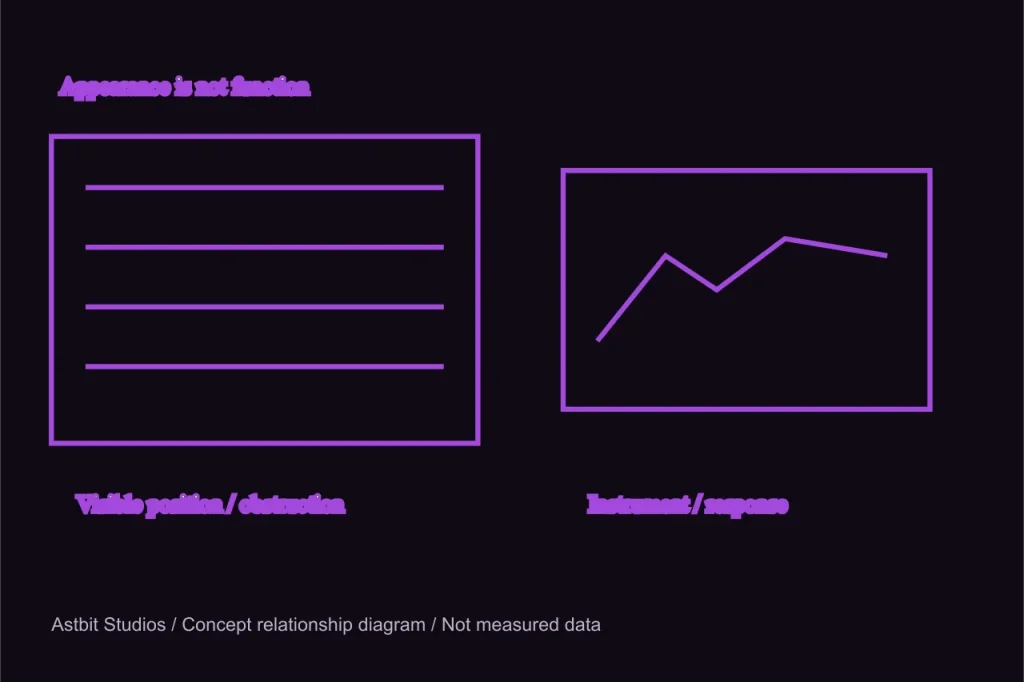
The panel looks intact
From the service gallery, the radiator can appear perfectly ordinary. Its fins remain deployed, reflected light moves across the surface, and the support structure has not visibly broken. None of that proves that the cooling loop is functioning as intended. This is a useful tension for Last Radiator: the environment supplies location and scale, while instruments supply information that a person could not reasonably obtain by looking through a window. The interface should respect that division rather than make every fault glow for convenience.
Decide what a view can honestly reveal
A window can show an obstruction, an obvious deployment problem or the orientation of equipment relative to the vessel. It can help the engineer understand which physical object a schematic represents. It cannot automatically reveal the condition inside a pipe or the state of every electrical connection. The concept needs a deliberate vocabulary for visible evidence. When the artwork reveals something, the player should be able to understand why that fact is observable from this position, rather than treating scenery as an arbitrary hint system.
Give instruments a narrow purpose
An instrument becomes easier to read when it answers a particular question. Instead of a universal health percentage, a selected check might compare the expected response on either side of a boundary. Another might establish whether a service is available before a planned observation. The exact quantities belong to a future model, but their relationship to decisions can be designed now. Each reading should have a location, a reason to inspect it and a clear limit on what it proves about the wider system.
Use light to orient, not to certify
Violet reflected light and small lime indicators establish the visual language of the gallery. They should not carry essential diagnostic meaning alone. A selected pipe can be identified with a label and a line pattern; an unavailable service can be named in text. The dramatic exterior scene remains useful because it connects the diagram to the ship’s shape. It becomes less useful if its colour changes claim certainty that the underlying evidence does not support. Atmosphere and explanation should reinforce one another without becoming interchangeable.
Preserve uncertainty where it matters
Some checks can narrow a fault without identifying it completely. The interface should be able to say that a branch is suspicious, or that a test has ruled out one explanation, without converting everything into a binary healthy-or-broken icon. This is not an excuse to be vague. The player still needs a specific next action and a reason it may help. The uncertainty should describe the state of the investigation, while the available controls remain concrete and understandable.
Connect the room to the reading order
When the engineer selects a component, the camera and diagram should help maintain orientation without forcing a long cinematic transition. A clear highlight can connect the chosen item to an inspection label, then return attention to the evidence. On this website, the same principle means keeping captions close to the relevant concept image and writing explanations in a sensible mobile reading order. The site is not the proposed cockpit interface, but it should make the relationship between the image and the design question easy to follow.
A small scene is enough to expose the problem
A first visual study could use one intact-looking panel, one visibly obstructed panel and a separate internal fault. The comparison would ask whether a player distinguishes appearance from function and chooses an appropriate check. That would require a real interactive implementation before conclusions could be drawn. The present illustration is concept artwork, and the accompanying schematic is an explanatory drawing. Neither is presented as evidence that such a study has already been completed or that any participants reached a particular result.
Read the procedure alongside the picture
The repair note follows what happens after an engineer isolates a branch. The Last Radiator concept explains the mission reason for restoring selected services. Read together, they define a restrained goal for environmental feedback: the room should help you locate the problem, the instruments should help you investigate it, and the procedure should leave enough evidence to decide whether your action actually helped.