
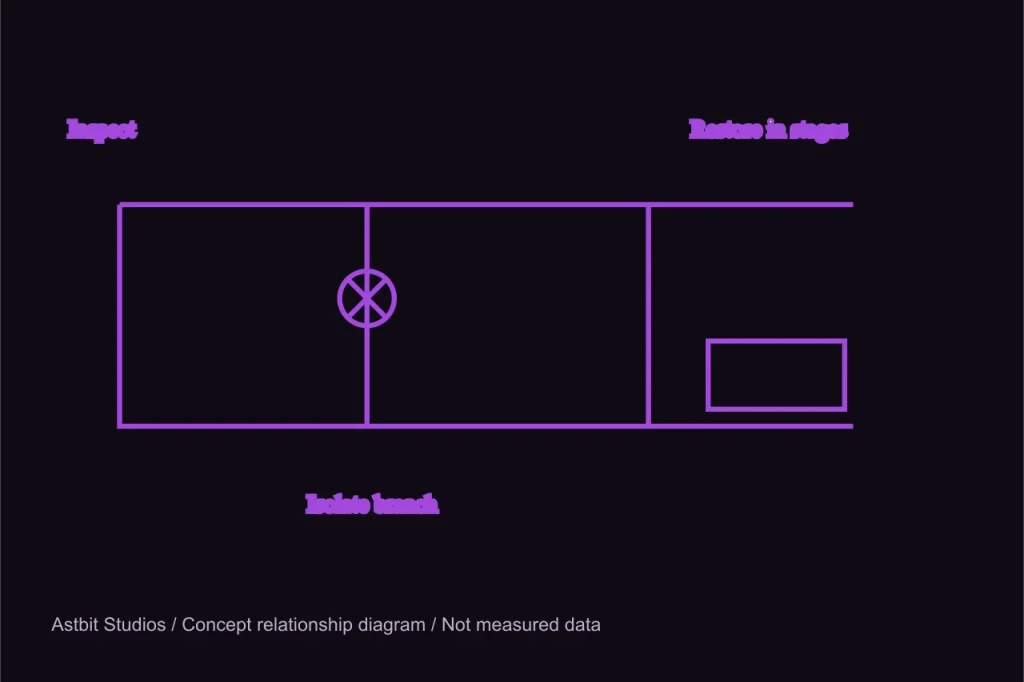
Begin after the obvious action
The engineer closes a valve and the warning disappears. In many fictional control rooms, that would be the entire repair. Last Radiator is interested in what happens next. The isolated branch may contain useful equipment, the remaining loop may carry a different load, and the original fault may still be present behind the closed boundary. A meaningful repair sequence needs to show those consequences. Removing an alert is not the same as restoring a capability, and the proposed interaction should make that difference tangible.
Identify the boundary before touching it
The service diagram should show which components sit on each side of a valve. A player inspecting a branch can trace its loads and the checks available after isolation. If a diagnostic device also loses power, the engineer needs to know that before closing the route. This does not require an enormous network. A few well-explained dependencies can produce more useful decisions than a dense diagram whose connections are decorative. The physical gallery then reinforces the diagram with visible labels and recognisable junctions.
Separate safety from recovery
Isolation can be the sensible immediate action even when it does not solve the underlying fault. The interface should acknowledge that achievement without claiming the system is repaired. A task can move from active fault to isolated condition, with a remaining question attached. What evidence would justify reopening the branch? Which observation can be made while it is disconnected? Keeping those questions visible prevents the familiar pattern in which a successful button press silently resets the entire situation to normal.
Give the remaining loop a voice
After a branch is closed, the surviving equipment should report its own changed situation. A trend may settle, a previously deferred task may become possible, or another load may still need to wait. The concept calls for a short, readable response rather than an instant green light. The player compares what was expected with what occurred. Any numerical behaviour would have to come from the eventual simulation model; the design illustration here only shows the ordering of checks and does not supply invented sensor readings.
Restore one obligation at a time
Reopening everything at once would obscure the cause of any new problem. A staged recovery gives each action a purpose: restore a small load, observe the response, then decide whether to continue. The game should remember which services the engineer promised to return before the next encounter. A workshop task might remain postponed while navigation equipment is restored first. That choice connects the procedure to the mission, so maintenance does not feel like an unrelated puzzle inserted between more important scenes.
Make a wrong hypothesis recoverable
A player may isolate the wrong branch for a reasonable reason. The design goal is not to make every incorrect diagnosis immediately fatal. Instead, the resulting evidence should help revise the hypothesis. If the expected change does not occur, the diagram and the room should make the next useful check easier to identify. Some choices can still have serious costs, but those costs need to be previewed where possible. A recoverable diagnostic loop encourages investigation without making actions inconsequential.
What would count as a useful prototype
The first planned study needs only two isolation boundaries, a small set of loads and one misleading initial symptom. Its question is whether the player can distinguish a safer condition from a restored function. A successful design would let the player describe both the immediate benefit and the remaining obligation after closing a valve. That is a proposed evaluation criterion, not a reported test result. We have not attached fabricated participants, percentages or completion times to the concept.
Return to the ship
The complete Last Radiator description places this procedure inside a service gallery with a damaged external panel. For the interface side of the problem, read What the Window Cannot Tell You. The connection matters: a repair needs both an action the engineer can perform and evidence they can interpret. The valve is a useful control precisely because the rest of that relationship remains visible after it moves.