
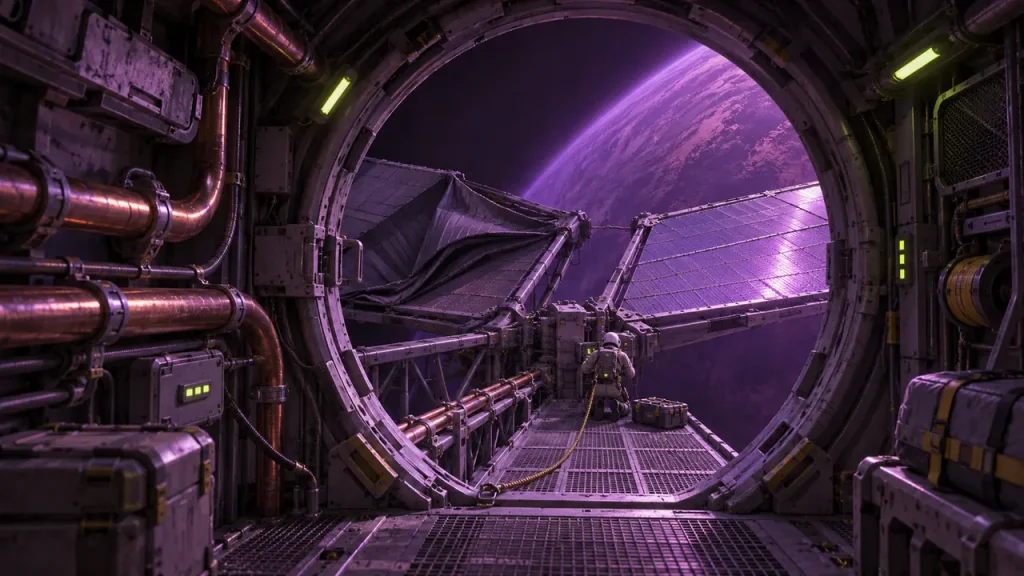
A ship with more equipment than cooling capacity
Last Radiator begins with a quiet fault rather than a fireball. One external panel no longer carries its share of the thermal load, and the remaining loop cannot support every scheduled task. The engineer stands in a service gallery where valves, power routes and inspection windows connect the abstract diagram to physical equipment. The problem is to preserve the functions needed for the next encounter while finding a recoverable configuration. This is a game concept with an intended prototype scope, not an available commercial release.
Follow the dependency
Selecting a component should show what it serves and what depends on it. A workshop may be expendable during the approach, but its power branch could also feed the device that checks a repaired pump. Turning off a load therefore creates an obligation as well as a benefit. The concept favours a small network with meaningful dependencies over hundreds of indistinguishable switches. Each operation should leave a visible trace: a closed valve position, an isolated branch on the diagram, or a task that now waits for another service.
Diagnose, isolate, restore
The proposed loop starts with inspection. You compare the readings available at two points and identify a useful next check, rather than guessing from a single red warning. Isolation follows: the engineer chooses a boundary that reduces the load while keeping essential observations possible. Restoration is slower and more revealing. Reopening a branch does not instantly prove that it is healthy. The player needs a way to watch a trend, notice whether the expected response occurs, and stop before committing the rest of the system.
Heat changes the timetable
The surviving radiator makes time a resource. A task that can be performed eventually may still be unavailable during a short observation window. The design asks whether the player can prepare for that window by cooling equipment earlier, postponing a workshop operation or accepting a less demanding route. These decisions connect the interior study to Slingshot Ledger without making either concept dependent on owning the other. Both concern a damaged ship, but one organises future geometry while the other organises present capability.
Make the room explain the diagram
The service gallery uses repeatable shapes for different kinds of connection. Coolant lines, electrical runs and access rails should not become the same bundle of glowing decoration. Inspection hatches give a view of the deployed panel, helping the player understand scale and orientation. Violet reflected light establishes the surrounding world; lime indicators mark selected actions sparingly. Text labels and distinct line patterns carry essential meaning alongside colour. A failure must remain readable when the scene is viewed without its most dramatic lighting effects.
What a first prototype would need to answer
The initial study would include a few loads, two meaningful isolation boundaries and one recovery procedure. It should test whether a player can predict the consequence of disconnecting a branch and recognise evidence that a repair has worked. A large list of component statistics is not the objective. The objective is a causal explanation the player can give afterward. There is no announced release date, verified performance model or downloadable build attached to this page. Read the valve and recovery note for a smaller example, or return to the system index to compare the concepts through observation rather than propulsion.