
Mission premise
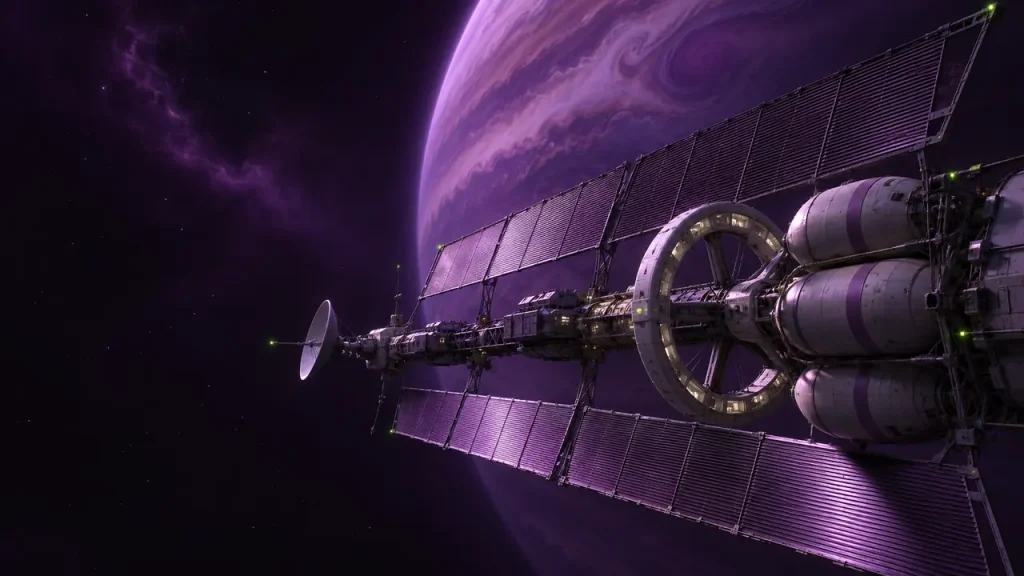
The survey ship Merrow approaches Vesper with enough propellant to correct its path, but not enough to waste a correction. A worn attitude-control assembly can still orient the main engine, provided the crew accepts a slower settling period. You take the role of the flight engineer preparing the encounter. The planet offers a chance to redirect the journey; the ship’s condition determines which approaches are worth considering. Slingshot Ledger is a concept for a deliberate navigation game, not a released simulator.
Read the approach before drawing the exit
The intended opening presents the current track, the planned encounter and the first observation after departure. You inspect the confidence of the navigation estimate before changing the route. A line should communicate more than direction: the interface needs to distinguish a committed path from a tentative alternative and a reliable observation from a prediction. The player can then move the encounter choice and watch the downstream requirements change. Nothing launches merely because a line has been dragged into an attractive position.
The loop of a single leg
First, examine the vessel’s usable resources and the quality of its current position estimate. Second, compare a small number of encounter plans. Third, prepare the systems required for the chosen correction. Finally, commit and review the resulting course. The review is part of play rather than an end-of-level medal. It explains which reserve was consumed, which uncertainty was reduced, and what the next leg now demands. A successful passage can leave a difficult repair problem, while a conservative passage can buy time to address one.
A turn that costs attention
A close encounter may produce a useful change in direction while allowing little time to check the final approach. A wider alternative may demand a later engine burn but leave a clearer observation window. The design goal is to make that trade legible without implying that closer is always better. Vesper’s surface and atmosphere supply visual context, while the mission display carries the actionable information. The artwork is a concept illustration; the proposed manoeuvres still require a carefully scoped numerical model before they could become a playable simulation.
What the engineer sees
Merrow’s exterior is arranged around long radiator panels, separated propellant stores and a small inhabited section. The ship should look like equipment built for a long job, not a fighter enlarged to interstellar scale. Inside, the route table remains the main reading surface. A side ledger records outstanding tasks in plain language: the next observation, the settling time before thrust, and the condition that would invalidate the current plan. The display should describe causes instead of generating warnings the player learns to ignore.
Prototype boundary
The first intended prototype would cover one approach, one correction opportunity and one departure review. It would not claim an entire galaxy, a complete economic system or a validated spacecraft engineering environment. The question is narrower: can a player explain why the chosen route is preferable for this damaged ship? If the answer depends on guessing an undocumented rule, the interface needs work before more destinations are added. Compare the dependency-focused decisions in Last Radiator, then read why a reserve needs a purpose. Return to the trajectory index to follow another system.