
Start with the wrong reassuring number
Imagine opening a route display and seeing a comfortable fraction of propellant remaining. The number appears to promise freedom. Yet the vessel may be unable to point the main engine quickly enough for the next correction, or the feed branch serving that engine may be isolated during a repair. The tank contains material, but the mission does not necessarily contain an opportunity to use it. In Slingshot Ledger, that distinction is a useful starting point for designing a reserve that means something beyond a coloured bar.
Give the reserve a job
A player should know what the held-back resource is protecting. One portion might support a departure correction after the planetary encounter. Another might leave room for an uncertain arrival estimate. These are proposed planning commitments rather than a claim that real spacecraft budgets can be reduced to a few labelled boxes. The interface can expose the commitments in ordinary language and let the player inspect their assumptions. Spending a reserve would then remove a named option, making the consequence visible before the decision is confirmed.
Separate stored from usable
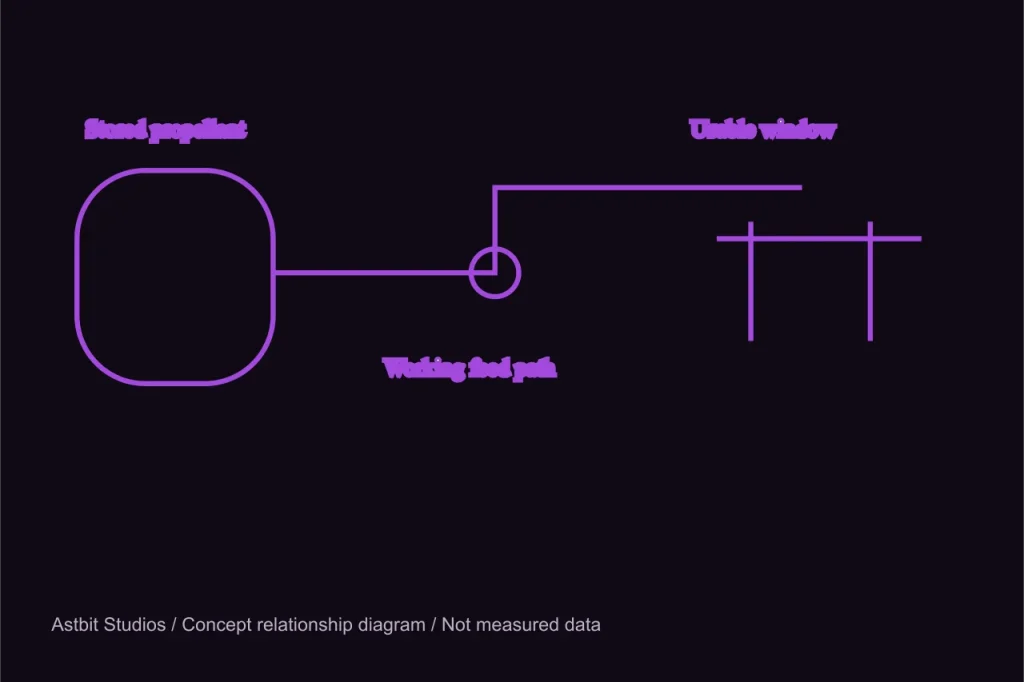
The concept diagram divides the question into three checks: material in the tank, a working route to the engine, and sufficient time to orient and fire. A failure in any one changes the meaning of the others. The proposed display does not need to combine them into a mysterious confidence score. It can show the three conditions beside the planned manoeuvre. That keeps the explanation local. A player who changes the repair schedule should see which condition improves, rather than discovering that an unrelated-looking total has moved.
Compare two departures
Consider an encounter plan that produces a large turn but leaves a short settling interval, alongside a gentler encounter with a longer interval before correction. A simple fuel-minimising display could make the first option look superior. A display that includes orientation time reveals why the damaged ship might prefer the second. The interesting choice comes from the relationship between route and condition. We would not want the game to punish a player for failing to anticipate a hidden settling rule that the planning screen never mentioned.
Show what changes when a reserve is spent
The confirmation should describe an option becoming unavailable, not merely ask whether the player is sure. For example, a late correction might consume the margin intended for a second observation-based adjustment. The route can remain viable, but the engineer now accepts more uncertainty. A clear ledger entry records that exchange. Later, the review can point back to it without pretending that every unfavourable outcome was avoidable. Good explanation is different from hindsight that makes a reasonable decision look foolish.
Keep the illustration honest
The diagram accompanying this note is a relationship sketch, not measured performance data. Its lines connect a store, a usable feed path and a correction window. Their lengths do not represent a calculated quantity. When a prototype supplies actual values, units and assumptions will need to appear where the player uses them. Until then, visual precision should not imply mathematical validation. A carefully drawn chart can be misleading if it looks more authoritative than the underlying design work deserves.
A bounded prototype question
For an initial study, one changing fault and two encounter alternatives would be enough. The question is whether a player can explain why the same tank quantity offers different choices in the two cases. If the answer requires memorising several screens of rules, the presentation needs simplification. If the player can identify the lost option and choose deliberately, the reserve has become part of the mission rather than a decorative penalty for using the engine.
Carry the question forward
The full Slingshot Ledger concept puts this reserve into an approach-and-departure loop. The next note, Make the Correction Window Readable, considers how the opportunity itself should be presented. Both are design proposals. Neither describes a completed simulation or a result from player testing. Keeping that boundary explicit lets the underlying question remain open while the mechanics and their explanation are developed.